
Why 92% of People Fail Their New Year Goals
Every January, millions of people wake up with the same electric feeling. This is the year. This time it’s different. The gym membership gets bought, the habit tracker gets downloaded, the vision board gets made.
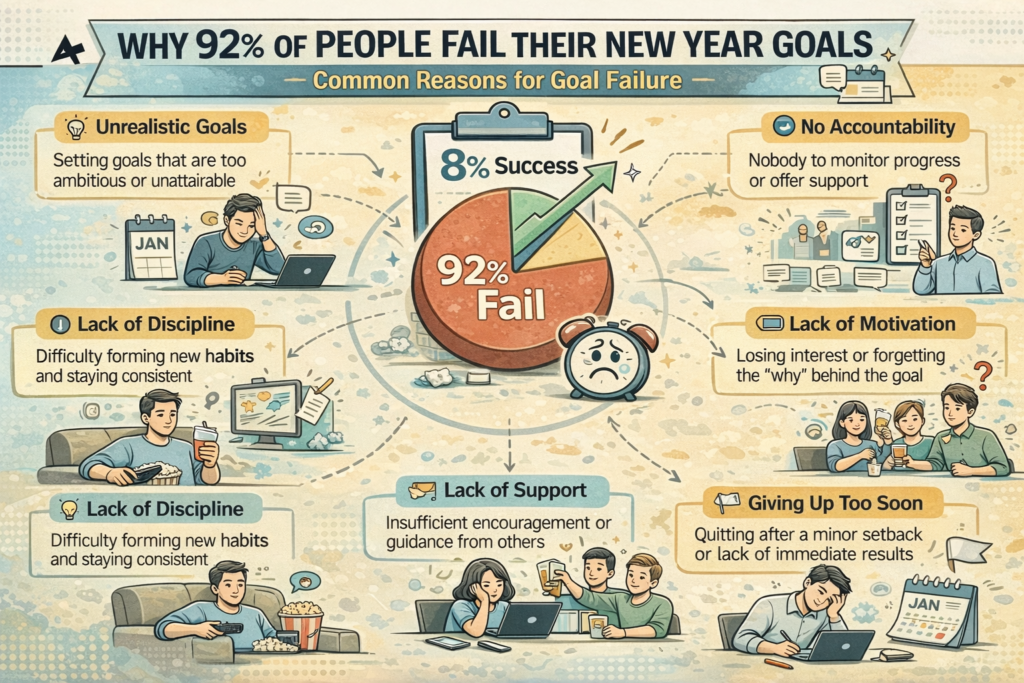
Research shows that roughly 92% of people never actually achieve their New
Year’s resolutions. Let that sink in. Out of every 100 people who set goals with genuine excitement and real intention, only 8 will see them through.

The Story We Keep Telling Ourselves
We love to blame ourselves when goals collapse. “I’m just not disciplined enough.” “I don’t have the willpower.” “Maybe I’m not cut out for this.” It feels honest, almost noble, to take that blame. But it’s also completely wrong.
Think about the last time you had a work deadline. A real one-with a manager waiting, a client expecting, a team depending on you. Did you miss it? Probably not. You figured it out. You stayed late, got creative, pushed through the resistance. The work got done.
Now think about the last personal goal you set. No deadline. No one waiting. No consequences if you skip today. Just you and your willpower, fighting against Netflix and exhaustion and the hundred small comforts that life offers every single day.
That’s not a character flaw. That’s just human nature doing exactly what it’s supposed to do.
What the Science Actually Says
Psychologists have studied goal achievement for decades, and one finding keeps showing up across every study, every population, every type of goal: people who are accountable to someone else are dramatically more likely to succeed.
The American Society of Training and Development found that having a specific accountability partner increases your probability of completing a goal by up to 65%. And if you have regular check-ins with that person? It jumps to 95%.
95%. That’s not a rounding error. That’s the difference between the 8% who make it and the 92% who don’t.
When someone else knows your goal, knows your timeline, and is going to ask you about it-something shifts in your brain. The goal stops being a private wish and becomes a commitment. It gains weight. It gains reality. And suddenly, skipping a workout or pushing off a deadline isn’t just letting yourself down. It’s breaking a promise.
Why Willpower Was Never the Answer
We’ve been sold a mythology around willpower for years. The idea that the people who succeed are simply stronger, more disciplined, more driven. That if you just want it badly enough, you’ll make it happen.
But willpower is a finite resource. It depletes throughout the day. It crumbles under stress, under sleep deprivation, under the ordinary weight of life. Even the most disciplined people in the world don’t rely on willpower alone-they build environments and relationships that make the right behaviors easier and the wrong ones harder.
Elite athletes have coaches. CEOs have executive coaches and boards they answer to. Entrepreneurs have co-founders and investors keeping them honest. The most successful people on the planet don’t succeed despite having accountability-they succeed because of it.
The rest of us have been trying to do the hard thing with none of the structure that makes it possible.
The Moment Everything Changes
There’s a specific moment that accountability creates, and if you’ve ever experienced it, you know exactly what I’m talking about.
It’s 7pm on a Tuesday. You’re tired. You told yourself you’d work on your side project for an hour tonight, but the couch is right there and your motivation left work at 5pm. In a world without accountability, you negotiate with yourself for twenty minutes and then give up.
But if you know that tomorrow morning someone is going to ask you, “Did you work on it last night?”-something completely different happens. You get up. Not because you suddenly found superhuman discipline, but because the social cost of saying “no, I didn’t” is higher than the effort of actually doing the thing.
That tiny shift in psychology is what separates goals that happen from goals that don’t.
Why Most Accountability Attempts Fail Too
Now, here’s where it gets nuanced. Because most people, when they hear “get an accountability partner,” try it and it doesn’t work either. They text a friend, check in for two weeks, and then it fizzles out. Life gets busy. The friend forgets to follow up. The whole thing dies without ceremony.
Real accountability isn’t just telling someone your goal. It requires structure. Consistency. A system that keeps showing up even when you and your partner are both tired and distracted. It needs check-ins that are scheduled, not spontaneous.
This is the gap that exists for most people. They know accountability works. They just don’t have a reliable way to make it stick.
Enter Accompli
This is exactly the problem Accompli was built to solve.
Accompli isn’t another productivity app asking you to build habits in isolation. It’s built around the understanding that accountability is the actual mechanism of change-and that mechanism needs to be structured, consistent, and social in the right way.
With Accompli, you set your goals and connect with accountability partners who are committed to showing up for the check-ins. The platform creates the structure so neither of you has to remember to follow through. Progress is tracked visibly. Check-ins are scheduled. Commitments are made in a space that makes them feel real.
It’s the difference between saying “I want to run a 5K” into the void and saying “I’m running a 5K, here’s my plan, and these people are going to ask me about it every week.”
The goal doesn’t change. The accountability does. And that changes everything.
The 8% Aren’t Special
Here’s the most important thing to understand about the people who actually achieve their goals: they aren’t more disciplined than you. They aren’t more motivated. They don’t have access to some secret reserve of willpower that you’re missing.
They just don’t go it alone.
The new year is full of possibility. Your goals are real. Your desire to change is real. What you need isn’t more motivation it’s the right structure around that motivation so it doesn’t evaporate the moment life gets hard.
Accountability isn’t a crutch. It’s the bridge between where you are and where you want to be. And for 92% of people silently struggling with goals they set and goals they abandoned, it might just be the only thing that was ever missing.