Self-Accountability Systems That Actually Work
You know that moment when you set a goal with every intention of crushing it, only to find yourself three weeks later having done absolutely nothing? You’re not alone. The problem isn’t your motivation-it’s that you’re trying to rely on willpower alone, which is like trying to run a marathon on a single energy bar. Self-Accountability Systems help with this issue.
Here’s what nobody tells you: self-accountability isn’t about being harder on yourself. It’s about building systems that make following through easier than giving up.
Why Your Brain Keeps Sabotaging Your Goals
Let me introduce you to Maria, a graphic designer who spent two years telling herself she’d “finally start freelancing on the side.” She had the skills, the portfolio, even a few potential clients. But every evening after work? Netflix won. Every single time.
The issue wasn’t laziness. Research shows our brains naturally gravitate toward immediate rewards over long-term benefits-watching TV right now feels better than the abstract concept of future income. This is a biological tendency, not a character flaw.
That’s why traditional goal-setting fails. Saying “I want to freelance more” is like saying “I want to be happier.” Cool, but what are you actually going to do at 7 PM on Tuesday when you’re tired and your couch is calling?
The If-Then Plan That Changed Everything
Maria tried something different. Instead of vague intentions, she created what psychologists call implementation intentions-basically, if-then plans that remove decision-making from the equation.
Her plan: “If it’s 7 PM on Tuesday or Thursday, then I will spend 30 minutes reaching out to one potential client.”
A meta-analysis of 94 studies involving over 8,000 participants found that people who used if-then plans had a medium-to-large effect on goal achievement, with an effect size of 0.65. That’s huge in psychology research terms.
What makes these work? When you encounter the “if” situation, your brain doesn’t waste energy negotiating with itself. You’ve already decided. The action becomes almost automatic. Maria stopped asking “should I work tonight?” and started simply working when Tuesday at 7 PM rolled around.
Within three months, she had five regular freelance clients. Not because she became more disciplined, but because she eliminated the daily decision that was draining her willpower.
The Accountability Partner Paradox for Self-Accountability Systems
Here’s something wild: just stating a goal to someone gives you a 65% success rate, but actually scheduling check-ins with an accountability partner pushes that number to 95%.
Think about Jake, a software developer who wanted to get back in shape. He’d tried gym memberships before-same story every time. Strong start, then gradual fadeout by week three.
This time, he texted his friend Marcus: “Going to the gym Monday, Wednesday, Friday at 6 AM. Can I send you a pic from there each time?” Marcus agreed. That’s it. No workout buddies, no matching schedules, just a simple text.
Research from Berkeley University showed that pairing up with a buddy for gym visits led to 35% more regular attendance than solo sessions, thanks to social pressure. And here’s the thing-it doesn’t even have to be someone who joins you. You just need someone who knows you said you’d do it.
Jake’s been consistent for eight months now. The secret? He knows Marcus is expecting that gym selfie. Missing it would mean texting an excuse, which feels way worse than just going.
The Money-on-the-Line Method (For When Nothing Else Works)
Some people need nuclear options. Enter Alex, a PhD student who kept putting off dissertation work until the last possible moment, then scrambling in panic mode.
He tried an app called Forfeit. The concept is brutal but effective: you commit to a specific task, and if you don’t do it, you lose money. Real money. Minimum $1, maximum $50 per failed task.
Alex set up: “Write 500 words of dissertation by 10 PM every weekday, or lose $25.”
The first time he considered skipping? That $25 price tag made him pause. Behavioral research shows people are more motivated to avoid a loss than to chase a reward-which is why this method cuts through procrastination like nothing else.
He’s written more in the past six months than the previous year combined. Not because he suddenly loved writing more, but because losing $25 for a task that takes 45 minutes felt absolutely ridiculous.
The Written Contract You Make With Yourself
Here’s a technique that sounds cheesy until you try it: writing yourself an actual contract.
Dr. Sarah Chen, a physician trying to maintain work-life balance, wrote this and stuck it on her bathroom mirror:
“I, Sarah Chen, commit to leaving the hospital by 6 PM on Tuesdays and Thursdays for the next month. If I don’t, I will donate $50 to my least favorite political organization. If I succeed, I get to buy those designer shoes I’ve been eyeing.”
Studies on weight loss found that people who voluntarily put their own money at risk were more likely to reach their targets because the fear of losing money kept them accountable.
Two things made Sarah’s contract work: First, the consequence actually hurt (donating to a cause she opposed). Second, the reward was specific and meaningful, not just “feel good about myself.”
She hit her goal 87% of the time that month. The three times she didn’t? She transferred $150 to political campaigns she disagreed with, which stung enough that month two had a 100% success rate.
The Environment Trick That Requires Zero Willpower
Sometimes the best accountability system is just making bad choices harder.
Remember David, who wanted to write a novel but kept getting distracted by his phone? He didn’t develop superhuman focus. He bought a $30 kitchen timer safe, put his phone inside, and locked it for 90-minute blocks.
Research on productivity shows that protecting basics like sleep, exercise, and focused work time amplifies self-control and the ability to stick with hard things.
Want to eat healthier? Don’t keep junk food in the house. Want to go running in the morning? Sleep in your workout clothes. Want to read more? Put your phone charger in a different room.
These aren’t accountability systems in the traditional sense. They’re anti-choice architecture. You’re designing your environment so the path of least resistance is the right choice.
David’s novel? 50,000 words in four months. He didn’t become more disciplined. He just eliminated the option to check Instagram every three minutes.
The Progress Tracking That Actually Motivates
Visual progress is addictive in the best way. Research highlighted that progress tracking works even better when it’s written down or shared with someone else, because what you measure, you start to care about.
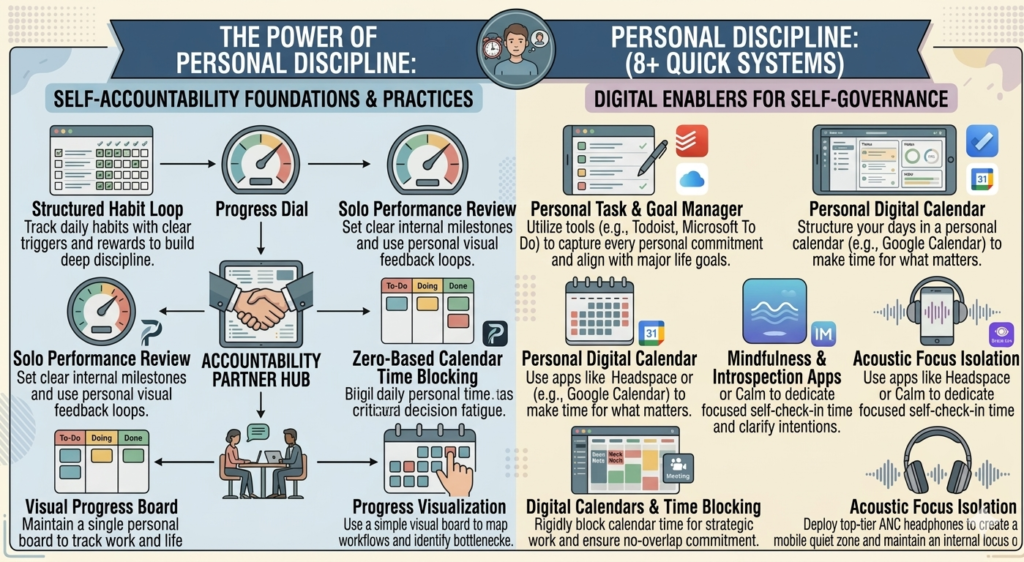
Take Nina, a marketing manager learning Spanish. She bought a wall calendar and drew a red X every day she practiced for at least 15 minutes. The rule: don’t break the chain.
Sounds simple, right? But after day seven, she had a week-long chain. After 30 days, a month. The chain itself became motivating. Breaking it after 30 consecutive days felt like throwing away a winning lottery ticket.
By month six, she was conversational. The X’s didn’t make her better at Spanish-they just made showing up non-negotiable.
You can do this with anything: workout days, writing sessions, sales calls, meditation streaks.
The format matters less than the visibility. Put it somewhere you’ll see it daily.
When You Slip Up (And You Will)
Here’s the part nobody talks about: even the best accountability systems fail sometimes.
Marcus skipped the gym. Maria missed a freelance deadline. Alex paid Forfeit three times in one week during finals. Sarah worked late five Tuesdays in a row during flu season.
The key is avoiding the “I’m terrible at this” narrative and instead noting it neutrally: that didn’t go as planned, what now?
The people who succeed long-term? They treat slip-ups as data points, not character judgments. Marcus didn’t think “I’m not a gym person.” He thought “I scheduled workouts on Monday mornings after weekend travel, which doesn’t work. Let me try Thursday mornings instead.”
Your accountability system should be designed to survive imperfection. Build in grace periods, backup plans, and reset mechanisms. A system that collapses after one mistake isn’t a system-it’s a setup for failure.
The Real Secret Nobody Wants to Hear
After researching dozens of studies and talking to people who’ve actually sustained major changes, here’s the uncomfortable truth: no single accountability system works forever.
Even naturally self-motivated people benefit from external accountability, particularly during phases when initial enthusiasm has waned but the end still feels distant.
Maria’s if-then plan worked great until she had too many clients and needed to delegate. Jake’s gym buddy accountability evolved into group fitness classes. Alex eventually didn’t need Forfeit anymore-the writing habit was ingrained.
The goal isn’t finding the perfect accountability system. It’s building the muscle of holding yourself accountable, then adapting your systems as your life changes.
Your Move
Pick one thing you’ve been meaning to do. Not three things. One.
Now choose the accountability method that makes you most uncomfortable in a productive way. If you hate the idea of telling someone your goals, that’s probably exactly what you need. If losing money would genuinely sting, use Forfeit. If visual tracking feels childish, buy that wall calendar.
The discomfort is the point. Comfortable systems don’t create change.
Set it up today. Not tomorrow. Not next Monday. Today.
Because here’s what I’ve learned from every successful person I studied: they didn’t become more motivated. They just stopped relying on motivation entirely.
They built systems that made success automatic.
What’s your system going to be?