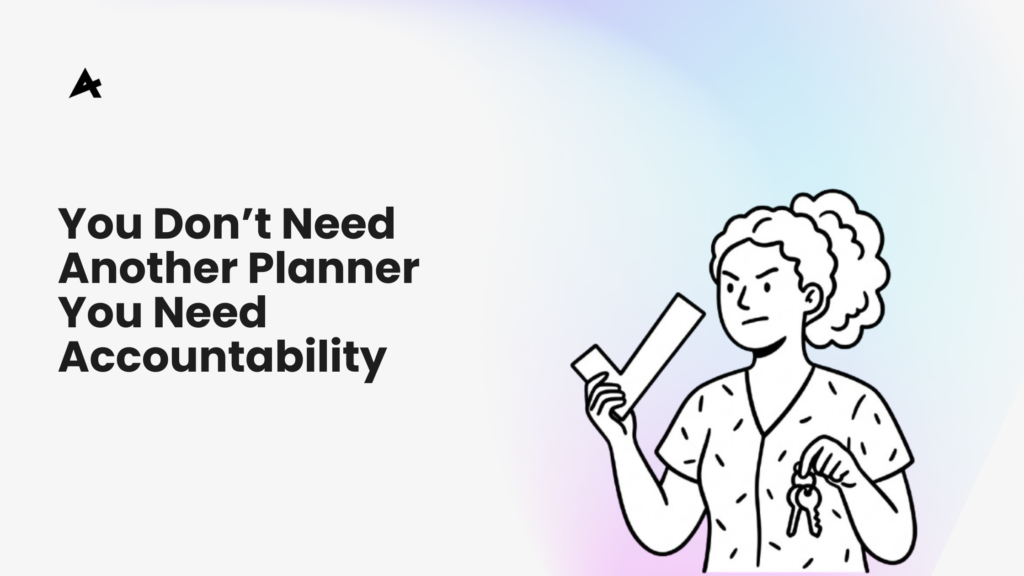
You Don’t Need Another Planner – You Need Accountability
A honest conversation about why your beautiful notebooks aren’t saving you
Let me guess. You have a planner. Maybe two. One for work, one for “life goals.” There’s a good chance at least one of them has a sunrise photo on the cover and a quote about rising and grinding. The pages inside are color-coded for the first two weeks of the year, then they slowly go blank, then completely empty, like a field after winter.
You bought it with the best intentions. You told yourself: this time will be different. This time you had the right system. And maybe for a little while, it felt different. Until it didn’t.
So what did you do? You went and bought another planner.
The Planner Is Not the Problem. You Are.
Here’s a truth that the productivity industry doesn’t want to put on a pastel sticky note: a planner can organize your intentions, but it cannot hold you to them. It sits there, silent and unjudging, ready to be ignored or rationalized or “started fresh Monday.”
The planner doesn’t care if you skip a day. It doesn’t ask why you haven’t opened it in three weeks. It doesn’t feel disappointed when you transfer the same unfinished task for the fifth time. That’s not a feature-it’s the flaw we keep paying for.
We are wired for other people. Every study on behavior change will tell you the same thing: social pressure, real commitment, and someone watching-even just someone who cares-changes how we perform. Not because we’re weak, but because we’re human.
Why We Keep Buying Systems Instead of Asking for Help
There’s something seductive about a new system. It feels like progress without risk. You don’t have to tell anyone your goal. You don’t have to admit you failed last time. You just buy a new notebook and quietly restart, alone, in private, safe from judgment.
But here’s the thing about staying safe: safe is where goals go to quietly die. The moment you tell someone-really tell them, not vague-post about it-something shifts. Suddenly the goal is real. It has a witness. And your brain, which is wired to care deeply about what others think of you, starts treating it differently.
This isn’t about shame. It’s about stakes. And right now, your planner has zero stakes.
What Real Accountability Actually Looks Like
People sometimes confuse accountability with punishment or harsh criticism. That’s not it. Real accountability is just a person who gives a damn, checking in consistently, and telling you the truth.
It could look like: A friend you text every Sunday with your one goal for the week-and who texts back every Friday asking if you did it.
It could look like: A small group of people who share their progress weekly without judgment, just honesty.
It could look like: A coach, a mentor, or even a colleague who you’ve explicitly asked to follow up with you.
It doesn’t have to look like: A formal arrangement, a paid program, or anything complicated. It just has to be real.
The Moment Everything Changes
Think back to a time you actually followed through on something difficult. A deadline you hit. A habit you built. A project you finished. Was there a planner involved? Maybe. But I’d bet there was also something else: someone who expected something from you. A deadline with a real person attached to it. A commitment made out loud.
You didn’t need a better system in that moment. You needed to matter to someone. To not let them down. That feeling-that small, specific human tension-is worth more than every color-coded weekly spread you’ve ever drawn.
That’s accountability. And you can build it on purpose, starting today.
So Where Do You Start?
You start by telling one person one real goal. Not a vague aspiration-a specific, measurable thing you want to do in a defined time. Then you ask them to check in with you. That’s it. That’s the whole starting point.
You can still use a planner if it helps you think. Use it to organize, to brain-dump, to sketch out your week. But stop expecting it to do the emotional and social work of keeping you committed. That’s not what paper does. That’s what people do.
The next time you feel the urge to buy a new journal, a new app, a new system-pause. Ask yourself: Do I actually need a better plan, or do I need someone to hold me to the plan I already have?