Goals vs. Systems: Which Actually Works?
We’ve all been there. January 1st, fresh notebook, brand new set of goals written in your best handwriting. Lose 20 pounds. Read 24 books. Save $10,000. Hit six figures.
By February, the notebook is somewhere under a pile of mail.

So what went wrong? Were you not motivated enough? Not disciplined enough? Did you just not want it badly enough?
Probably none of those things. The problem might be simpler-and more fixable-than you think. You were playing the goals game when you should have been building systems.
Let’s Be Honest About Goals First
Goals aren’t bad. I want to be clear about that before we go any further. Goals give you direction. They tell you where you’re pointing. Without a goal, you’re just running in circles and calling it cardio.
But here’s the uncomfortable truth about goals: they’re essentially just wishes with a deadline attached.
“I want to publish a book by December” is a goal. It tells you what you want and when you want it. What it doesn’t tell you is what to do on a random Tuesday afternoon when you’re tired, distracted, and your inbox has 47 unread messages. And that Tuesday afternoon? That’s where your life actually happens.
Goals live in the future. Systems live in the present. And execution-real, consistent, unglamorous execution-only ever happens in the present.
What a System Actually Is (And Isn’t)
People hear “system” and immediately picture spreadsheets, color-coded calendars, and the kind of hyper-organized person who labels their spice rack alphabetically. That’s not what I mean.
A system is simply a repeatable process that removes the need to make a decision every single time.
Think about it this way. Two people both want to get fit. Person A sets a goal: “I will work out five days a week.” Person B builds a system: “Every morning at 6:30, I put on my workout clothes before I make coffee. My gym bag stays packed and by the door.”
Why Goals Fail at the Execution Level
The biggest problem with relying purely on goals is what I’d call the “arrival fallacy”-the idea that once you hit the goal, everything will be different. You’ll feel successful. You’ll feel organized. You’ll finally feel like you have it together.
But goals are binary. You either hit them or you don’t. And the moment you miss a milestone, the whole thing starts to feel like failure. So you course-correct with more motivation, more pressure, more intensity -until you burn out and the cycle starts again.
Systems don’t work that way. A system that you follow 80% of the time is still doing something for you. It’s building a groove. It’s creating a default. When you miss a day, you don’t fail the system-you just run it again tomorrow.
The Part Nobody Talks About: Systems Without Goals Are Pointless
Here’s where I’m going to push back on the purists who say “forget goals entirely, just build systems.”
A system with no direction is just a habit. And habits without intention can take you very efficiently in the completely wrong direction.
I’ve talked to plenty of people who are incredibly disciplined and organized-they have morning routines, they batch their work, they’ve automated everything automatable -and they’re still not getting where they want to go. Because their systems are optimized for motion, not progress. They’re busy without being directed.
A Practical Way to Think About This
Here’s a framework that I’ve seen work well-for myself and for people I work with.
Start with the goal, but quickly translate it into a system question. The moment you write down a goal, ask yourself: “What would I have to do consistently, even on my worst days, for this to happen?” That answer is your system.
Say your goal is to grow your newsletter to 10,000 subscribers. Great. Now stop thinking about the number and ask: what does Tuesday look like? What does Thursday look like? What gets published, when, and how often? What’s the process for promoting it? What happens when you’re traveling or sick or just completely uninspired?
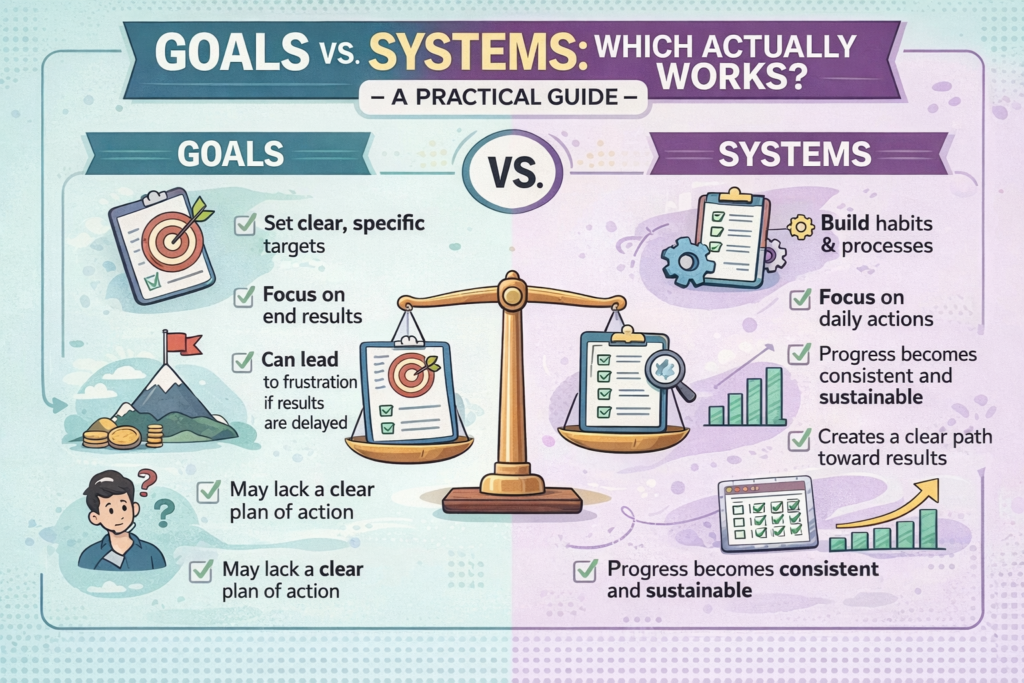
The goal is the destination. The system is the road.
The Real Secret Is Lowering the Stakes of Each Individual Day
One of the most underrated benefits of systems is that they take the weight off any single day. When you’re purely goal-focused, every day that you don’t make visible progress feels like failure. Every week that the number doesn’t move is a crisis.
But when you’re system-focused, a good day is simply a day where you ran the system. You wrote the words. You made the calls. You shipped the thing. Whether the results showed up today or not is almost beside the point-because you know that results are the downstream product of consistent behavior over time.
This is what separates people who execute well from people who are just endlessly motivated and endlessly starting over. The consistent executors aren’t necessarily more talented or more driven. They’ve just stopped treating every day like a performance and started treating it like practice.